Movie reviews 2014




EXODUS: GODS AND KINGS
12/24/2014
As the concept of Ridley Scott, the director of Bladerunner, could have made a bad film is laughable to me, I went to see Exodus on Christmas.
While it isn’t his best work, the film has unforgettable visuals, a cast led by Christian Bale that give superb acting performances, and an interesting visual interpretation of G-d as Moses interacts with “it.”
Film is an interpretive art. While this story focuses on the exodus of the Jews from the enslavement by the Egyptians, as related in the Bible, of course there are inaccuracies. There has never been a definitive pinpoint in as to which Pharaoh was in power at the time of Moses (the story begins in 1300 b.c., at which point Israel was already a power in the mideast), if the figure of Moses as a member of the royal household is mythic or true, if the Jews left Egypt en masse, if some of the miracles stated occurred, if the Red Sea parted and swallowed up Pharaoh’s army. However, as with so many other religious stories, we have been handed them down to learn from them. The Mosaic laws are the most famous moral code of the Judaic history, adopted into later religions.
Ridley Scott has made this epic with heart. It is extremely entertaining and moving. Put aside your pre-conceived notions and go on this cinematic journey he has created, which at heart, is a journey of the dream of liberation for those who have not tasted it yet, the hardships and rewards of seeking the path of righteousness and trust in a higher power than any man’s. This is the ultimate story of Moses, which Scott captures. You will not be disappointed.
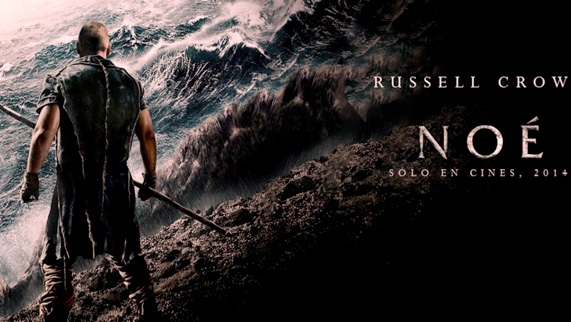
NOAH
3/28/2014
Since Darren Aronofsky burst onto the scene with his screenings of Pi at the Sundance Film Festival in 1998, this Harvard film graduate has continued to amaze with his remarkable approach to subject matter that forces his audience to ponder on theories when they leave a theater.
He has, however, begun to pile on the pyrotechnics since his debut feature.
Unfortunately, in Noah, the CGI of angelic forces seen coming to Noah’s aid in building the Ark are downright childish. As well, the rather one-note interference of Tubal-Cain felt formulaic. I was disappointed in what appeared more a Peter Jackson Noahic recreation than a purely Aronofsky voice in this film. There were totally missed opportunities to get a good sense of the jeering and laughter associated with the many years Noah spent building what was seen as a folly. Instead, Aronofsky skips those years to focus on the desperation near the time of the deluge.
I want the believable in the unbelievable when I watch a film, even if the story is outside the realm of reality. While children might buy this (though most of this is too violent for young children) and perhaps gamers will recognize this as an acceptable world, I didn’t.
Nonetheless, the film is saved by its entertainment value and magnificently acted portrayals. Emma Watson is stunningly wonderful in this film as Noah’s adopted daughter and daughter-in-law, showing her promise as a matured young actress of her generation. Russell Crowe as Noah shows he continues to be a force to be reckoned with on film, despite the faux pas of his work in Les Miserables (a bad casting chioce). Jennifer Connelly as Noah’s wife is compelling, though distractingly modern in temperament for this part. Logan Lerman as Ham is touchingly youthful and vulnerable in his role. Anthony Hopkins portrayal of Methusaleh, created by Aronofsky, hints at the mystery and magnificence this film could have attained if he’d cared to delve with more seriousness into the spirituality of the story.
Choosing to portray Noah as believing his mission is to do G-d’s bidding and wipe out humanity creates a high tension, but is not biblical, as the Bible clearly states G-d told Noah he intended to save Noah’s family, including the wives of his three sons. Aronofsky rewrites the Bible here by only portraying one son as having a wife, thereby forcing a conflict that drives his film’s story concept. The mystery of the youngest son finding Noah drunk and naked is also not truly addressed because the entire story isn’t set up according to the biblical story. Nonetheless, Aronofsky’s vision creates that question in the minds of his audience, Is humanity fit to rule the earth today?
THE GRAND BUDAPEST HOTEL
3/28/2014
I’ve gone cross-eyed from Wes Anderson films. The Royal Tannenbaums was a hoot, but wasn’t it getting over on attitude, the star power of Ben Stiller and some cool-ray-specs costume work? The Life Aquatic was a strange jumble of characters, so strange I didn’t follow the story with eagerness. Then he went claymation with Fantastic Mr. Fox. But now he’s knocked me out in a good way with a one-two-three punch: The Darjeeling Express, Moonlight Kingdom, and The Grand Budapest Hotel.
I see Wes Anderson studied philosophy at the University of Texas in Austin where he met Owen and Luke Wilson. So perhaps it’s unsurprising that in these films, there are protagonists examining the core of their being. They are all––though most obviously in Moonlight Kingdom––coming-of-age stories; a trinity of characters in Darjeeling. In The Grand Budapest Hotel, it’s the lobby boy Zero, performed to comic perfection by an 18-year-old actor Tony Revolori. His guru is the effete hotel manager, M. Gustave, played with stunningly fanatical reserve by Ralph Fiennes. The story is told in flashback by an older Zero, known as M. Mustafa (F. Murray Abraham).
Wes Anderson loaded this film with smaller roles performed by the likes of Bill Murray and Tilda Swinton. Adrien Brody is a bad guy; Willem Dafoe is eviler. The enchanting Saoirse Ronan plays a scullery maid with a large facial mole.
And, oh my goodness, the score by Alexandre Desplat is perfection.
As he did with Moonrise Kingdom, Anderson chose to use a “nostalgic” frame size. In this case, of 1.37:1, first used in 1928. The film does throw a nod at that time period when the silents crossed into the talkies. Wes Anderson plays with the hyperbole reflected in the scriptwriting of that earlier era to create a frothy comic concoction; when Gustave is wrongly convicted of a crime, the antics he and his lobby boy go through to clear his name is Keatonesque. And yet, the story concludes on a touching, human note.
I highly recommend everyone see this wonderful film.
Movie reviews - 2014


Mar 30, 2014





